what age do babies not want to be put down
Knowing near safe sleeping positions for babies is of import in ensuring a prophylactic sleep surroundings and preventing the risk of sudden baby death syndrome (SIDS). SIDS falls under the category of sudden unexpected expiry in infancy (SUDI) and is majorly linked to the position in which the baby sleeps. Thus, knowing what positions are safety for your babe to sleep in is important to aid prevent unexpected situations. Also, knowing a few tips that volition help reduce the chance of SIDS helps get a long fashion (1). Ane instance of such a position of prophylactic sleeping in babies is the supine position, in which the baby, who is less than a year old, is made to sleep on their back. Read on to know more than near safe sleeping positions for babies and tips on sleep safety.
The Skillful And Bad Positions For A Babe To Sleep
Information technology is essential to learn nearly the safe and unsafe sleeping positions for a infant to bargain with the higher up risks (ii).
1. Sleep on back
Salubrious babies born full-term should be placed on their backs for naps, short periods of residual, and sleep at dark.
- 'Sleep on the dorsum' position was found to lessen the risk of SIDS in babies, every bit it keeps airways open up.
- The U.s. National Constitute of Kid Wellness and Human Development (NICHD) labeled this as the best sleeping position for babies (three).
- Since the American Academy of Pediatrics made the 'back-to-sleep' recommendation in 1992, the SIDS rate has dropped more than l%. The 'back-to-sleep' recommendation was subsequently campaigned as 'safety to sleep' (4).
Risks Involved In 'Sleep On Back' Position
If infants are placed on the back for a long time, it may atomic number 82 to 'positional plagiocephaly,' a case of flattened or misshapen head and 'brachycephaly,' the flattening of the back of the skull. The shape volition become normal past the time they plough one twelvemonth and rarely requires any treatment Simple repositioning techniques may be employed to avoid such conditions. They include:
- Increasing 'tummy fourth dimension' of the baby when awake
- Making the infant rest on the other side of the head rather than the apartment side.
- Cut down the time spent by babies in carriers or motorcar-seats.
- Getting more 'cuddle time'.
- Irresolute the direction of the baby in the crib so that they do non always view the same things, and in one management always.
ii. Slumber on stomach
Several theories discourage parents from making a babe slumber on the stomach because:
- It could put force per unit area on a baby's jaw, reducing the airway and restricting breath.
- If the infant sleeps on the stomach, i.e., in the prone position, they may be lying with the face very close to the sheets and breathing the same air.
- The baby may suffocate while sleeping on the tummy if the mattress is very soft.
- The babe may besides breathe in microbes present on the mattress.
When Can Babies Sleep On Stomach?
In rare cases, due to a medical condition, doctors may suggest parents to make the baby sleep on the tum rather than the back.
- A few physicians believe that sleeping on the breadbasket could be adept for babies with severe gastroesophageal reflux or certain upper-airway malformations like Pierre Robin Syndrome, which pb to astute airway obstruction episodes. Nonetheless, no recent study supported or refuted the benefits. Healthcare providers should consider the potential benefits and risks before recommending this position.
- The danger of vomiting was the most of import argument for making the baby sleep on its stomach. This is considering doctors believed that information technology would be dangerous if the baby vomits while sleeping on the back. They argued that babies might choke on their vomit, due to lack of enough forcefulness to plough the head. However, babies sleeping on their backs may not have every bit much difficulty turning their heads and vomiting the contents of the tum out.
- Likewise, you may make a baby with colic slumber on the tummy to relieve them of gas. Withal, do not do it immediately later on feeding them. Let at that place be some gap betwixt the feed and the sleep fourth dimension.
3. Sleep on the side
Information technology is unsafe for babies to sleep on the side because they may terminate up on the breadbasket, increasing the chance of SIDS.
In addition to the good and bad sleeping positions, you must also know about the sleeping practices that could pb to a sudden unexpected death in infants.
Related Products
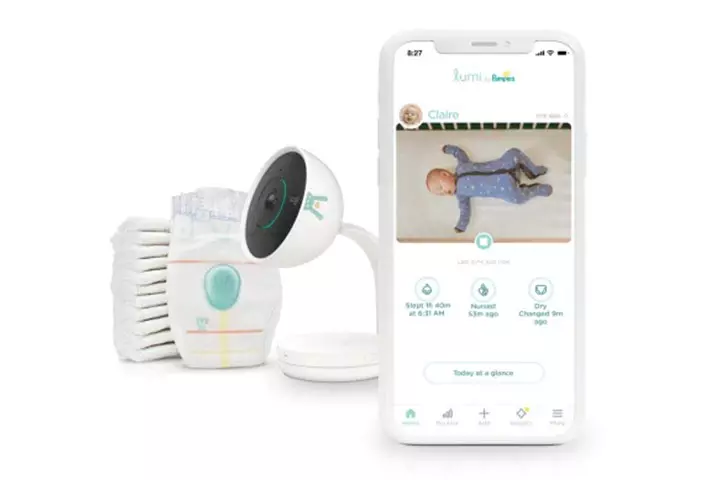
Pampers Lumi Baby Monitor

Sleeping Practices That Could Lead To Sudden Unexpected Death In Infancy (SUDI)
SUDI includes both SIDS and other fatal sleeping accidents. Here are a few practices that could lead to SUDI:
- Making the baby sleep on the stomach or side.
- Putting the babe to sleep on soft surfaces such equally mattress, sofa, waterbed, pillow, or lamb'due south wool, either with or without a parent around.
- Covering the baby'southward head or face with bedding, which may cause adventitious suffocation and overheat.
- Smoking during pregnancy or after childbirth.
SIDS can be a significant gamble and should be considered when you follow certain steps to ensure that your baby sleeps safely.
xi Tips For Condom Baby Slumber
For babies who are healthy and under one year of historic period, sleeping on the dorsum is the ideal position. However, some actress measures would exist helpful to ensure safe sleep for your baby (1).
- Avoid loose bedding: It is advisable to employ a house mattress rather than an overly soft mattress, waterbed, or sofa for your baby. Experts propose against the usage of bumper pads, pillows, fluffy bedding or stuffed animals around the baby in the crib. In simple words, anything that could cover a baby's head or face during sleep is not recommended.
- Go along the crib simple: Practise not use wedges, quilts, or comforters under an baby in the crib. Allow the infant sleep with the feet touching the bottom of the crib so that he tin't wriggle down under the bedding. Utilise a firm, clean mattress that fits the cot well and tuck in the bedclothes deeply. The sides or ends of the crib should be loftier enough to prevent the baby from climbing out or crawling out.
- Avert covering the baby'due south head: Blankets should exist covered only up to the chest of the infant with arms exposed, to avoid the shifting of the blanket onto the head and thereby preventing suffocation. The American Academy of Pediatrics recommends using 'sleep sack' or 'baby sleep purse' as a type of bedding to keep him warm without roofing the head. Sleeping numberless with a fitted neck and armholes and no hood are considered the safest. Wrapping a baby in lightweight cotton wool or muslin likewise helps in preventing him from rolling onto the tummy during sleep.
- Avert overheating: Infants should be clothed lightly for slumber. Avert over-bundling and cheque if the baby is not hot to touch.
- Good sleep surroundings: It is of import to maintain a considerably cool sleeping surroundings with a temperature of around 20oC for the baby.
- Vaccination: An investigation done on diphtheria-tetanus-pertussis immunization and potential SIDS clan by the Berlin School of Public Health has concluded that increased DTP immunization coverage is associated with decreased SIDS mortality (5). Electric current recommendations on timely DTP immunization should be emphasized and followed to forbid non merely specific infectious diseases but likewise potentially SIDS.
- Apply a pacifier (at sleep times): The American University of Pediatrics considers pacifiers could preclude SIDS. Withal, do not force the babe if they do not want it or if it falls out of the oral cavity. If y'all are breastfeeding, wait until it is well established before offset to utilise a pacifier. Information technology ordinarily takes around iii to 4 weeks of historic period for the babe to go comfortable with breastfeeding.
- Utilize technology: If you lot are worried near the baby's sleeping position, especially when they are in a separate room, use Wi-Fi baby monitors, app-powered thermostats, or minor alarms to monitor the sleep position as well as vitals of your baby.
- Avoid use of products that claim to foreclose or reduce SIDS. This is crucial as scientifically, there is no known mode to forestall SIDS. Safety and efficacy of wedges, positioners, or other such products that merits to preclude SIDS are non proven. On the contrary, various incidents take been reported where these products have been associated with injury and death when used in the babe'south sleep expanse (6).
- Share the same room: You lot may share the same room with the babe for user-friendly breastfeeding and contact. The crib in which the baby sleeps should exist closer to parents.
- Avert sharing the bed: Experts suggest that infants ideally should not share the bed with parents, adults, siblings, or other children. Twins or multiples may be made to sleep separately. Exercise not share a bed with your infant, especially if you or your partner have been drinking, smoking, or taking medications or drugs that could induce deep sleep. Smoking and the use of a substance like drugs or alcohol significantly increase the take a chance of SIDS and suffocation in babies, if the bed is shared.
Ofttimes Asked Questions
1. What if the infant rolls onto the stomach while sleeping?
Around four to five months of age, babies begin to scroll over onto their stomach from their back (7). This tin be alright as the SIDS run a risk more often than not lowers by this time. Allow the baby find a comfortable sleeping position; they may be able to turn the face to the side to keep the mouth and olfactory organ free for breathing when sleeping on the stomach. In any case, always place the infant on the back when you lot put them downward on the bed to sleep.
Notation that the SIDS risk is at a peak between i and iv months of historic period, but it remains a threat until babies are 12 months old. So, follow other precautions to reduce the gamble of SIDS all through your baby's commencement year.
2. Why does my baby sleep in fencing reflex while in the back-to-sleep position?
Babies exhibit many involuntary movements as they grow. I such move is the Fencing Reflex or Tonic Neck Reflex (eight). When placed on the back-to-sleep position, the infant's head turns to one side with the arm and leg of that side extended, while the other arm and leg are flexed. This is called the fencing position, which helps prevent a baby from rolling over onto the stomach earlier the torso is ready for it. This is 1 more than reason for putting your baby to slumber on the dorsum. This involuntary move volition disappear anytime between three to half dozen months of age.
3. When can the baby be on its stomach?
The babe may be put on the stomach, merely under supervision, when awake. Giving tummy time for babies is a good way to strengthen their tum, back, and cervix muscles.
According to Dr. Karen Sokal-Gutierrez, clinical professor, customs health and human evolution, University of California Berkeley-UCSF Joint Medical Program, SIDS risk is lowered with babies spending more breadbasket time when they are awake (nine). Moreover, the babe would develop upper body strength needed to lift the head and roll over in sleep.
4. Can I use infant sleep positioners for my infant?
There is no US FDA blessing for infant sleep positioners to reduce or preclude the risk of SIDS in babies.
five. What if babies throw up when sleeping on the back?
In that location is a low take chances for healthy babies to asphyxiate on vomit when fabricated to sleep on their backs than on their sides or tummies. Sleeping on the back does non increase choking risk in babies with gastroesophageal reflux illness either. But do not put the baby to bed with a canteen propped for feeding. This practice could lead to ear infections and choking.
6. What to do if my baby has difficulty sleeping on the dorsum?
A few infants may not have a deep sleep in the back-to-slumber position. Some may even become fussy when placed on the back.
The baby may non feel comfortable sleeping on the back if they accept a congested nose. In such a example, place a humidifier in the infant's room to moisten the air and loosen the congestion. Elevating the head slightly could minimize the discomfort from a stuffy olfactory organ.
vii. What if my baby throws upwardly while sleeping?
If your infant throws up, turn their caput to the side. Make clean up the vomit and change the bedding earlier you put the baby dorsum to sleep once more.
8. What are the best sleeping positions for preterm babies?
According to a research study, preterm infants are at a higher SIDS risk, and they are to be placed on the dorsum-to-slumber position (10). All the same, in a highly monitored inpatient setting, sleep on stomach position may be appropriate in instance of acute respiratory affliction in preterm infants.
In the first few months, you need to exist extra conscientious with your baby and their habits, including their sleeping position. Learning virtually the right sleeping position for babies holds dandy importance in ensuring their safety and preventing any unfortunate events such equally SIDS. What may seem like a normal harmless position, such as sleeping on the side and the tum or sleeping on too soft surfaces, can increase the take a chance of the condition. So consult your doctor to know about safe positions for your baby to sleep in and follow the precautionary tips to help your baby have a safe and comfy slumber.
References:
MomJunction's articles are written after analyzing the enquiry works of good authors and institutions. Our references consist of resources established by regime in their respective fields. You lot can acquire more than about the authenticity of the information we present in our editorial policy.
The post-obit two tabs change content below.
- Reviewer
- Author

Dr. Rajeev Ranjan is a senior neonatologist and pediatrician at the Nidan Mother And Child Intendance Clinic in Noida, India. He completed his Md from Tsma-Tver Medical University, Russia, in 2005, DCH from Dr. D. Y. Patil Medical College (Mumbai), and FCH, MCH (Delhi) in 2004. With eighteen years of feel, Dr. Ranjan is a fellow member of the Indian Medical... more

Swati Patwal is a clinical nutritionist and toddler mom with over eight years of feel in diverse fields of nutrition. She started her career equally a CSR projection coordinator for a healthy eating and active lifestyle project catering to school children. So she worked every bit a nutrition faculty and clinical diet omnibus in unlike organizations. Her interest in scientific writing... more
barreirocarturestry.blogspot.com
Source: https://www.momjunction.com/articles/safe-sleeping-positions-for-babies-and-newborns_0094200/
0 Response to "what age do babies not want to be put down"
Post a Comment